Gate T: the track after the fact
A classical search over manoeuvre histories, a gate on test seed 331, and what the panel narrowed
12 November 2026 · spec 013 · gitma2 · nothing trained
A different question
- Not "where is the target now?" but "what did it do over the last half hour?"
- All the bearings in hand: one every 5 seconds, 20 to 60 minutes.
- The answer is a track: position, course and speed at every moment, and when it manoeuvred.
Told the manoeuvres, the fit is at the bound
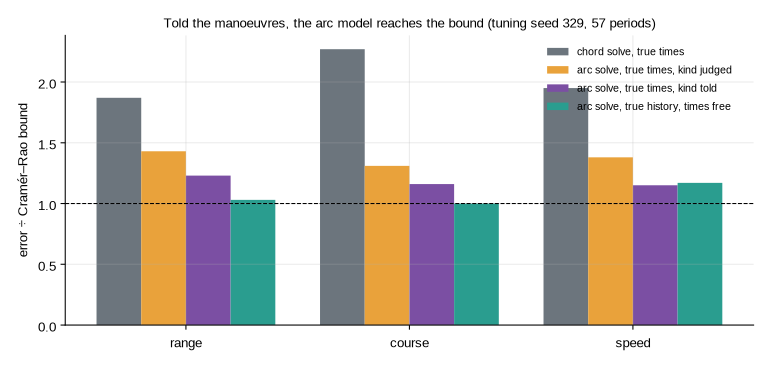
Tuning seed 329. A turn modelled as an arc at a constant rate brings the fit from 1.9 × the bound to about 1.2. The model is not the limit.
But the bearings do not say which history
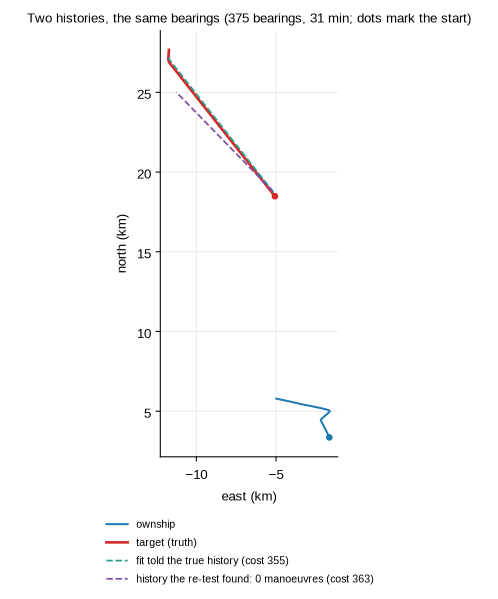
A test of fit reaches the true history's cost with a third of manoeuvres missed. What separates histories is knowledge of how targets manoeuvre.
The search
- Propose histories: add, remove or change a manoeuvre.
- Fit each with the arc model and Annex B's statistics.
- Score each by its evidence.
- Return the best few as candidate tracks with probabilities.
The first registration stopped itself
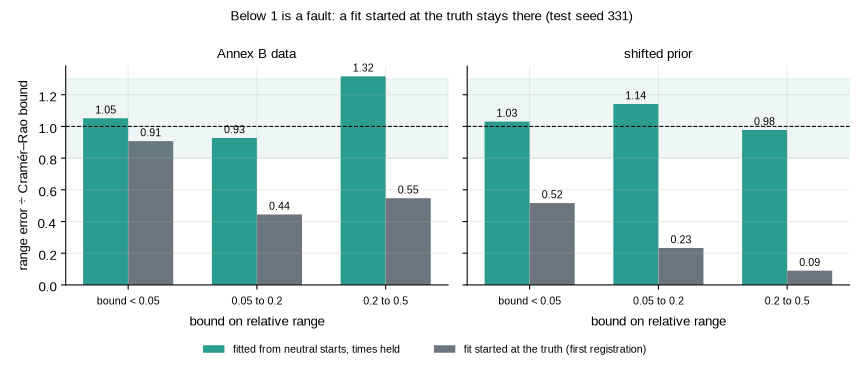
The reference scored below the bound: it had been started at the truth and stayed there. The gate stopped at validation; the owner re-registered with a reference fitted from neutral starts and every threshold unchanged.
The gate on test seed 331
| Check | Result | Outcome |
|---|---|---|
| T-a reference at the bound | 1.05 (band 0.8–1.3) | pass |
| T-b C″ ÷ search above 1.10 | 2.27 [1.76, 2.67] | pass |
| T-c the same, shifted prior, above 1.00 | 1.69 [1.39, 2.14] | pass |
| T-d candidates | 0.71 in first three; gap −0.03 | pass |
| T-d-shift calibration | gap +0.32 | fail, as forecast |
| T-e search ÷ reference | 1.46 [1.24, 1.91] | material |
300 periods per split. Decided by the panel in one round: five approve with findings.
Every system as a track
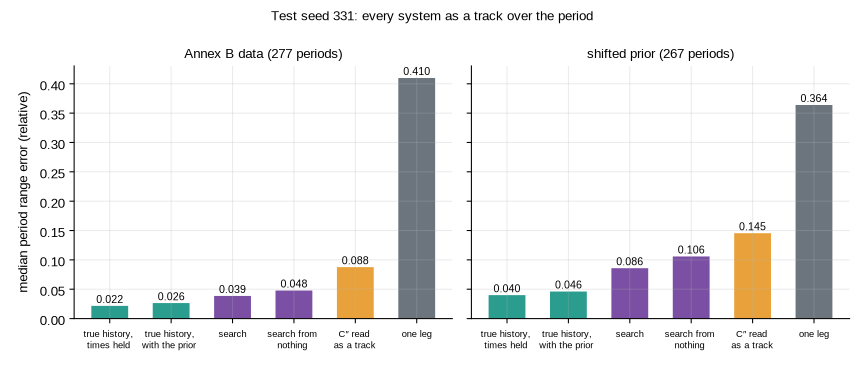
C″ 0.088, search 0.039, reference 0.022 on Annex B data. The IMM and EKF give no state on most rows and are not drawn.
Three seeds
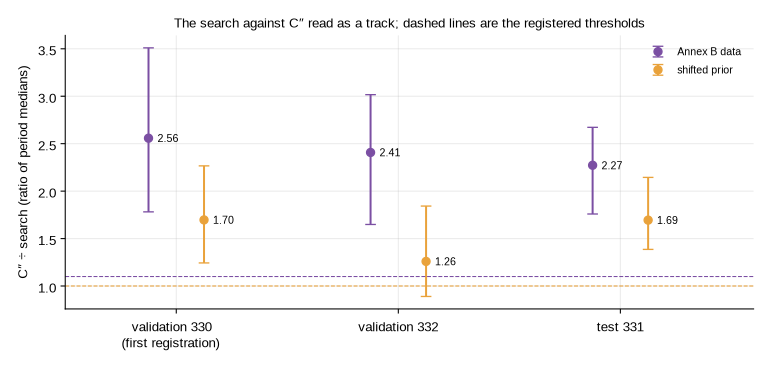
Stable on Annex B data. Under the shifted prior one of three seeds would have failed: the pooled figure is about 1.6.
What the panel narrowed
- "2.3 times better" → a ratio of medians. Period by period 1.7; worse than C″ in 30% of periods.
- "The search finds the history" → it wins where its history is wrong too. Mostly smoothing with a model and a prior.
- "Room left: 1.46" → an upper limit. Paired 1.17; the gap sits only where the history is wrong.
- The soundness check would have passed the faulty reference.
It under-counts manoeuvres
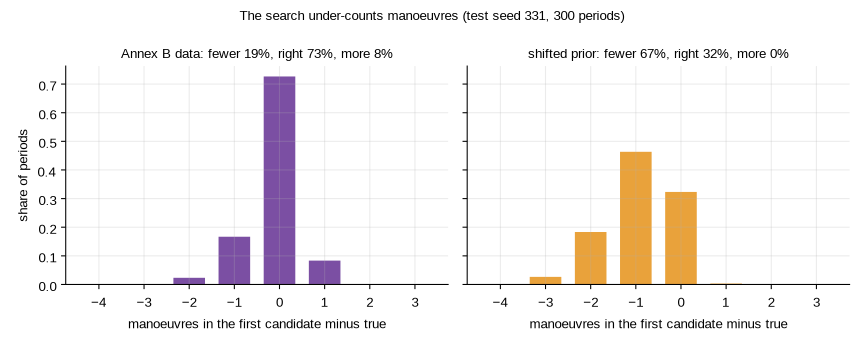
23% of true manoeuvres missed on Annex B data, 41% under the shift. With no manoeuvre at all (12 periods) it invents one in 7 of the 12.
Probabilities: honest on average only
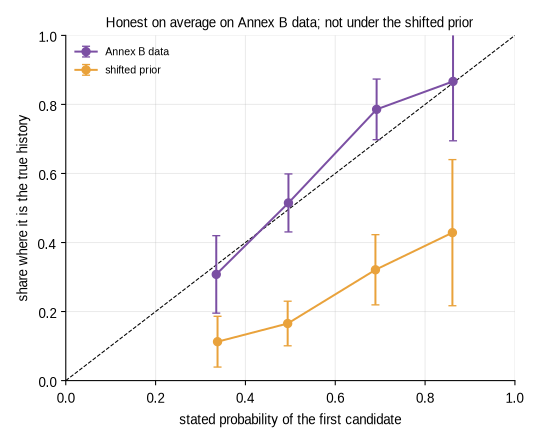
Under the shifted prior the candidates carry a ranking and no probability, and nothing tells the analyst which regime applies.
What was not achieved
- The owner's bearing-rate thinning study.
- A target that never manoeuvres, and the false-manoeuvre rate.
- Correlated or outlying bearing errors; whole engagements; a smoothed IMM.
- The control that separates the search from the model and prior.
- Any real data: the fitting model is the generator's own.
What comes next
- The owed classical studies and controls.
- A search robust to a wrong prior, with a diagnostic for it.
- Then a learned whole-period model, registered against the search under the same prior.
The choice is the owner's; no GPU run before it. Write-up: /blog/2026/11/12/gate-t · record: experiments/20261112-gt2 (review.md)