Time-late, repaired and re-registered
The numbers hold, the rule says no, and the reference matters most
13 November 2026 · spec 015 · gitma2 · nothing trained
Where spec 014 left us
- The evidence gave a manoeuvre's duration about 600 s of volume against a density tens of seconds wide.
- The classing counted manoeuvres cut by the period's edge.
- The true-history reference drifted into other histories in 13% of periods.
Owner's decision: repair, and decide the same quantities again on fresh seeds (336, 337).
Three repairs
Plus: every table generated from the summary by script, after spec 014's hand-copied row.
A target that never manoeuvres
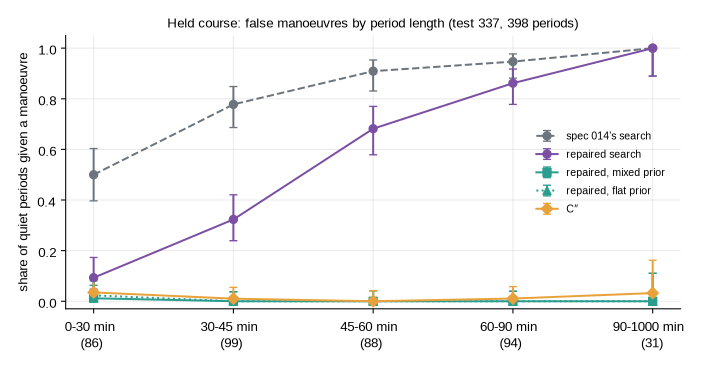
Repaired search 0.53 overall (spec 014's on the same periods 0.80). Short periods: 0.50 to 0.09. Long periods: unchanged, because Annex B says a target probably manoeuvres within the hour.
The repair is not free
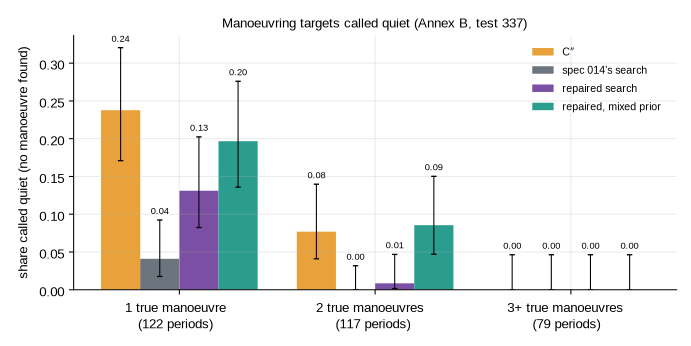
One-manoeuvre targets called quiet: 4% before, 13% after, 20% with a stated half chance of a quiet target. Integrated numerically these misses are within a nat of undecidable.
The decided quantities on three seeds
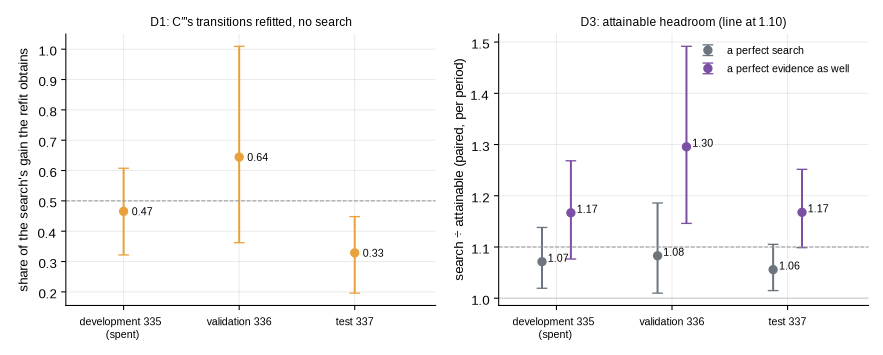
Test seed 337: D1 0.33 [0.20, 0.45]; headroom 1.06 and 1.17 [1.10, 1.25]. The lower limit is 1.099 against a line of 1.10: inconclusive, and by the rule no GPU budget.
The headroom is a convention
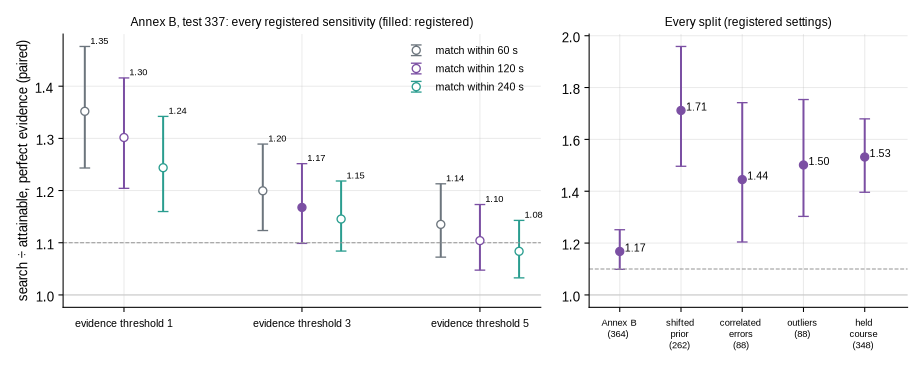
1.08 to 1.30 across the registered sensitivities. Large on every split where the simulator's assumptions fail.
What the panel found: the reference decides it
| Reference on replaced periods | Headroom | By the rule |
|---|---|---|
| Registered (held where it drifts) | 1.17 [1.10, 1.25] | inconclusive |
| Free-time fit throughout | 1.15 [1.08, 1.22] | inconclusive |
| Without held periods | 1.13 [1.06, 1.20] | inconclusive |
| Held periods as no gain | 1.11 [1.05, 1.17] | inconclusive |
| Times held everywhere | 1.19 [1.11, 1.28] | material |
19 held references carry a third of the gain; ten periods carry over half. A fit told the true times knows more than which history is right. Panel recomputation, not a registered result.
Five approve with findings
- Every decided number reproduces; no bug changes one; registration held.
- The rule's output is "no GPU budget". Our first record softened it; corrected.
- The evidence repair is not finished: the pairing fails at the edges of the prior's support (fifth error of this family).
- Short-period 0.09 is not what a correct evidence gives: the prior favours "some manoeuvre" almost everywhere.
- "Ambiguous" share is the threshold's: 0.11, 0.44, 0.66 at thresholds 1, 3, 5.
What was not achieved
- Each repair's effect on each decided quantity, separated, on the same periods.
- Unit tests for the decided statistics' code.
- A fall-back that catches runaway refits: it caught one of seven.
- A decision at the 10% line: 400 periods cannot make one.
- Any remedy for a shifted prior, correlated errors or outliers.
What comes next
- A hedged track from the stored candidates; a declaration margin.
- Robust and correlated-error likelihoods; a prior that can be wrong; a small stated chance of a quiet target.
- Scored where the gaps are: shifted prior 1.7, correlated errors 1.4, outliers 1.5.
- Then a learned whole-period model, registered against those controls.
The choice is the owner's; no GPU run before it. Write-up: /blog/2026/11/13/time-late-repair · record: experiments/20261113-tl3 (review.md)