Time-late, the classical follow-on
What the search is worth, what it gets wrong, and two faults the panel found
13 November 2026 · spec 014 · gitma2 · nothing trained
Where Gate T left us
- A search over manoeuvre histories halved the track error of C″.
- The panel: is that the search, or just a better model and a prior?
- How much is left to win, and is any of it within reach?
- What happens when the target never manoeuvres?
Owner's decision: classical work first, no GPU.
Two controls split the gain
The refit keeps C″'s manoeuvres and adds everything but the search. The flat-prior search adds the search but knows nothing of how targets manoeuvre.
Every system, three kinds of target
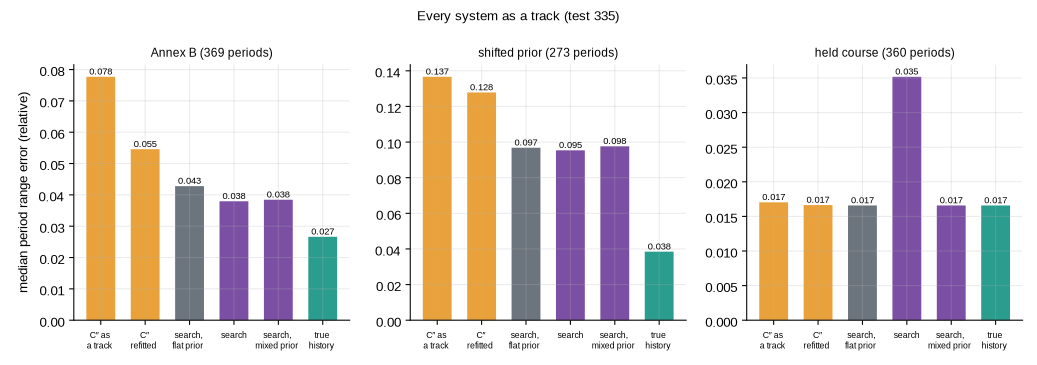
C″ ÷ search: 2.13 on Annex B data, 1.53 under the shifted prior. On held course the informed search is the worst system.
What was decided, and the forecasts
| Forecast | Result | |
|---|---|---|
| D1 share of the gain from the refit | 0.75 | 0.43 [0.28, 0.58] |
| D2 wrong histories: ambiguous / search / evidence | 0.45 / 0.10 / 0.45 | 0.53 / 0.08 / 0.39 |
| D3 headroom, perfect search | inconclusive | 1.04: not material |
| D3 headroom, perfect evidence as well | material | 1.10 [1.04, 1.18]: inconclusive |
| D4 false manoeuvres on held course | 0.80 | 0.76 |
| D5 learned whole-period model | by the rule | no GPU budget |
Three forecasts wrong, all as one tuning seed of 134 periods pointed. Panel: five approve with findings.
Three seeds
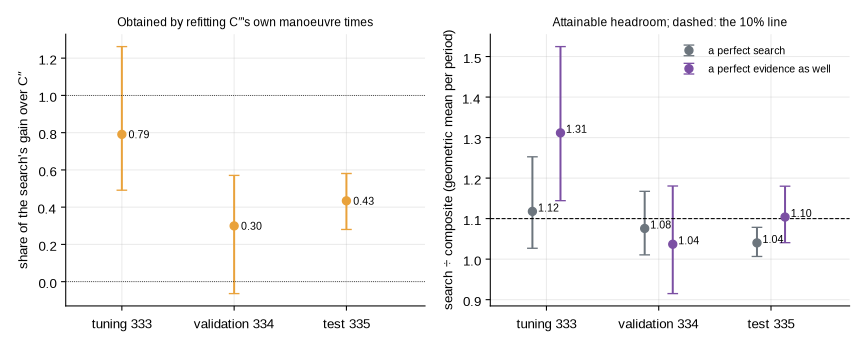
The panel: "about half", not "under half" (0.39 to 0.58 by definition; 0.47 over three seeds). The headroom is on the 10% line: 1.05 to 1.20 by convention.
Defect 1: the evidence rewards short manoeuvres
- The prior: a small change lasts 20 to 120 s.
- The evidence allowed its duration about 600 s of room.
- Each small, short manoeuvre gets a bonus it has not earned.
- With a corrected volume the false rate on quiet targets is 0.47 to 0.57, not 0.76.
Found by the panel's code reviewer. Recorded, not repaired: the code is registered.
Defect 2: manoeuvres cut by the period's edge
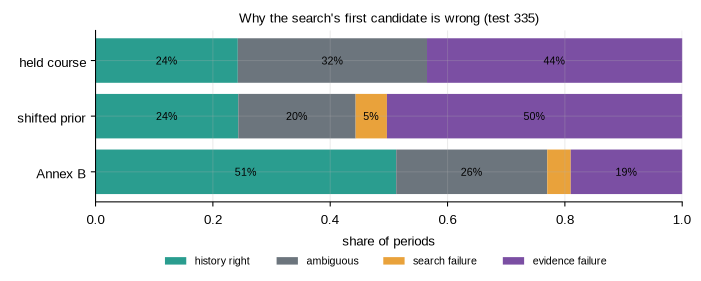
The classing counted manoeuvres the spec says to leave out. Without them: wrong histories 0.57 / 0.11 / 0.33, first candidate right in about 60%. And "ambiguous" means this approximate evidence was close, not that the bearings cannot decide.
A target that never manoeuvres
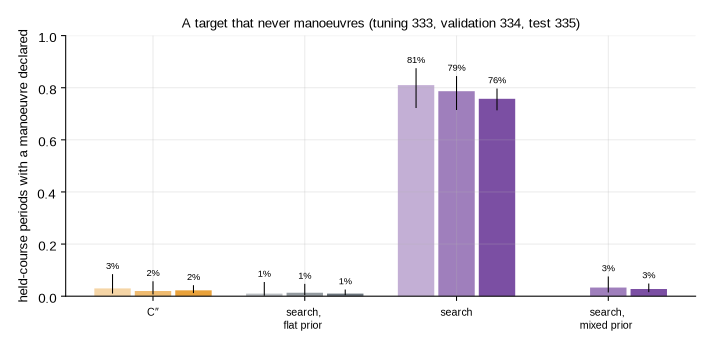
Over an hour the search invents one almost always; under 30 minutes still 46%. The mixed prior fixes it, at a cost the first draft denied: it calls a once-manoeuvring target quiet in 20% of periods against 6%.
Where the assumptions are wrong
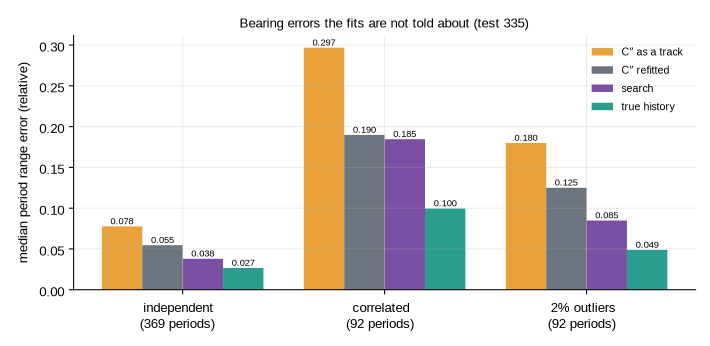
The rule for D5 reads the left group only. The gaps to the right are 1.5 to 1.6 and nothing, classical or learned, was built against them.
The owner's thinning idea
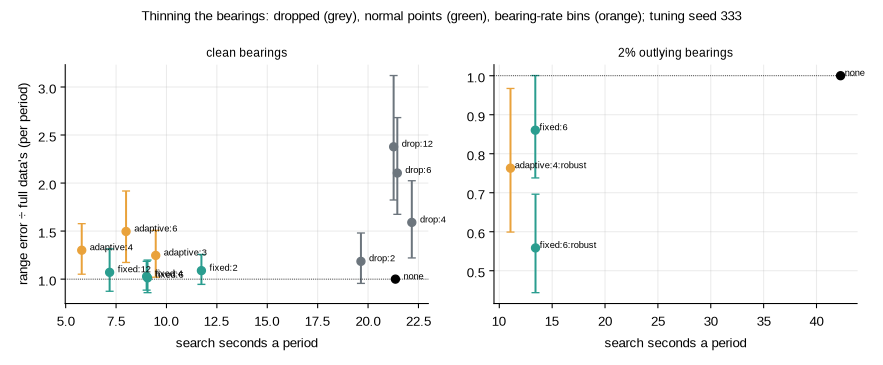
Dropping loses; fixed normal points halve the run time at a cost not separated from zero or from 20%. The bearing-rate bins (orange) were set by noise: the idea is not yet tested.
What was not achieved
- A sound evidence: four volume errors so far, the last still in.
- A prior that can be wrong, and a way to tell; a robust likelihood in the search.
- A fair test of bearing-rate bins; the wild-bearing edit on its own.
- A hedged track from the candidates; an IMM smoother.
- Any real data: the fitting model is the simulator's own.
What comes next
- Repair the evidence, the classing and the reference; register and run again.
- Classical work against the real gaps: robust likelihood, correlated errors, a prior that can be wrong.
- A hedged track as the control for any learned model.
- Only then a learned model, on the shifted, quiet and mismatch splits.
The choice is the owner's; no GPU run before it. Write-up: /blog/2026/11/13/time-late-classical · record: experiments/20261112-tl2 (review.md)