What We Built
A schema-driven Properties Panel that edits STAC item metadata from two surfaces. When a plot is open, a 4th section appears in the ActivityPanel alongside TimeController, Tools, and Layers. When no plot is open and the analyst is triaging the catalog, a Properties area stacks under ThumbnailPreview in StacBrowser. Same form, same field set, same service path.
The form is generated from the LinkML-derived JSON Schema for the STAC item type. PropertiesForm in shared/components/src/PropertiesPanel/ walks the schema and maps each property to either a ParameterEditor widget (scalars, enums) or one of four new sibling widgets: ArrayWidget for chip lists, DateTimeWidget for ISO-8601, BboxWidget for the four-quad, PlatformArrayWidget for platform records. Add a field in LinkML, run make generate, and a new input appears on the next build – confirmed by the round-trip test in test_properties_panel_roundtrip.py.
Screenshots
The PropertiesForm rendering the metadata for a catalog item, against three VS Code theme variants. Two fields carry chips: datetime is auto-derived from feature timestamps, start_datetime is override because the analyst overrode it once, so subsequent derivation passes skip it.
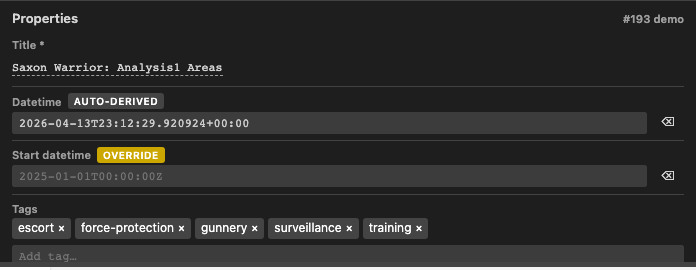 Dark theme.
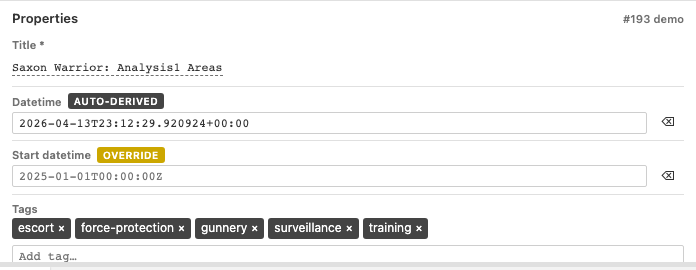 Light theme.
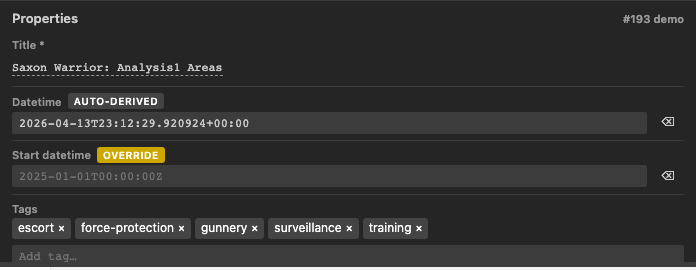 VS Code sidebar theme.
Schema-invalid input is rejected inline – no disk write, no provenance entry. Here an invalid ISO-8601 datetime surfaces an inline error next to the field, and the original value on disk is unchanged until a valid commit lands:
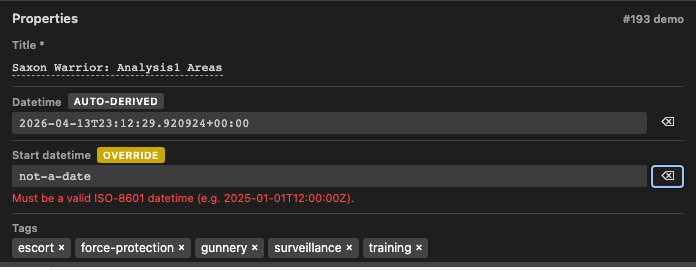 Inline validation error.
How It Works
Writes go through a single gatekeeper: stacService.updateItemMetadata. Read, record mtime, merge patch into item.properties, append a provenance entry, re-stat to detect concurrent edits, atomic temp+rename onto item.json. No session-state staging, no parallel write path, no last-write-wins. The same method serves the ActivityPanel and the StacBrowser – the “which surface is editing?” question never becomes a “which writer wins?” question because there is only one writer.
Auto-derivation is now override-aware. stacService.updateTemporalMetadata reads item.properties["debrief:overrides"] and skips any field listed there. Edit start_datetime once, and subsequent derivation passes leave it alone. The Properties form renders those fields with an “override” chip so the analyst can see why derivation isn’t running for them.
The provenance log is bounded. The active array on item.properties["debrief:provenance_log"] caps at 500 entries; the 501st commit rotates the oldest entry into a sibling provenance_log_archive.jsonl in the same item directory. Append-only JSONL, atomic rotation. Reads stay O(cap); the full audit trail is preserved on disk (Article III.3).
Key Decisions
Dropping the session-state staging layer made the write path much simpler. The planning post described edits “staging into session-state and flushing when the plot is saved, piggy-backing on the existing unsaved-changes machinery.” The review rejected that. Session-state is UI-only in this codebase; data changes go through services. Adding a PropertiesSlice to flush-on-save would have introduced a parallel write path alongside stacService, and the two surfaces would have had different persistence models for the same form. Direct-write through updateItemMetadata on every commit collapsed all of that to a single method.
mtime-based stale-edit detection is enough. No cross-platform file locks, no lease protocol, no lock files. Read, fingerprint the mtime, do the merge in memory, re-stat before rename. If the mtime changed, throw StaleItemJsonError and let the UI reload from disk. Last-write-wins is avoided without any of the portability cost that real locking would bring.
Bounded log + JSONL archive is a pattern, not a one-off. The rotation machinery for debrief:provenance_log is small, well-tested, and exactly what feature-level provenance will need when #192 lands. We’ll re-use the same shape rather than inventing a second convention.
By the Numbers
| Tests passing | 78 |
| Schema round-trip + structural | 13 |
| stacService (write path, rotation, overrides) | 12 |
| Widgets + form + schema resolver | 48 |
| StacBrowser selection context | 3 |
| Provenance log cap | 500 entries |
| Overflow destination | provenance_log_archive.jsonl |
What’s Deferred
This is a correctness-first landing. Storybook stories, Playwright webview E2E, a host-side hydration hook that feeds live item.json values into PropertiesForm, and the StacBrowser GoldenLayout wrapper are all deferred to follow-ups. The pieces are exported and tested in isolation; wiring the extension host and capturing demo assets comes next.
What’s Next
- #192 – feature-level metadata. The same form machinery extends to per-feature
debrief:feature_tags. Thedebrief:overridesarray grows a second dimension keyed by feature ID. - Platform autocomplete.
PlatformArrayWidgetwires the platform registry in so analysts pick from known platforms instead of retyping ids. - Unified provenance rotation. The per-item rotation policy generalises to per-feature provenance logs; one cap, one archive shape across item and feature surfaces.