What We Built
A storyboard wants to tell a story, and stories often hover on a single instant. An analyst framing the moment of intercept wants a wide context shot, a zoom on the contact, and a zoom on ownship — three scenes at the same timestamp. Until this change, the Storyboard refused the second and third captures as “duplicate timestamp”. Analysts worked around it by nudging the clock forward a second per scene, which is dishonest to the underlying analysis: those viewports really did belong to the same moment.
| Before | After |
|---|---|
Capture scene at 10:30:00Z — accepted |
Capture scene at 10:30:00Z — accepted |
Capture second scene at 10:30:00Z — rejected, “duplicate timestamp” |
Capture second scene at 10:30:00Z — accepted, appended to the tied group |
| Multi-viewport snapshots forced to fake the clock by a second | Multi-viewport snapshots share one honest timestamp |
| Tied scenes impossible | Tied scenes ordered by capture sequence, reorderable within the group |
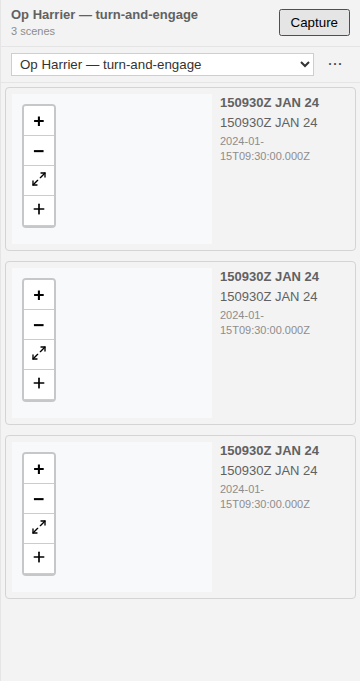 Three scenes captured at the same
 timestamp but at different map viewports. The panel lists them in capture order; the new creation_order secondary sort does the work the old uniqueness constraint used to do.
How It Fits
The change lives in the schema layer of the Storyboarding feature line. SceneProperties in storyboard.yaml gains a creation_order integer slot, regenerated Pydantic and TypeScript types flow outward through @debrief/schemas, and the structural consumer is shared/components/src/storyboard/. Two existing inline sort sites in the VS Code extension’s panel view and playback engine fold onto a single canonical listScenesOrdered() helper, which now sorts by (timestamp, creation_order). No service changes, no new runtime dependencies, persistence path unchanged.
Key Decisions
- An explicit
creation_orderfield, not insertion order. Insertion order is fragile across JSON round-trips and merges. An integer per scene, scoped per-Storyboard, gives a stable secondary sort that survives serialisation and any future reordering UI. - One sort site, not three. Pre-change,
listScenesOrdered()had two inline copies in the VS Code extension. Folding them onto the canonical helper is the structural cleanup that comes for free with the behavioural change — and pays back the next time the ordering rule evolves. - No backward-compatibility shim for legacy plots. A pre-#259 Storyboard has scenes without
creation_order. Rather than infer values at load time, the loader rejects such plots with a namedUnsupportedSchemaVersionErrorand bumpsschema_versionfrom 1 to 2. Article XIV (pre-release freedom) authorises the hard break: no shipped user data exists, and silent inference would mask cases where two analysts disagree about what the right order was. An honest error beats a quiet guess.
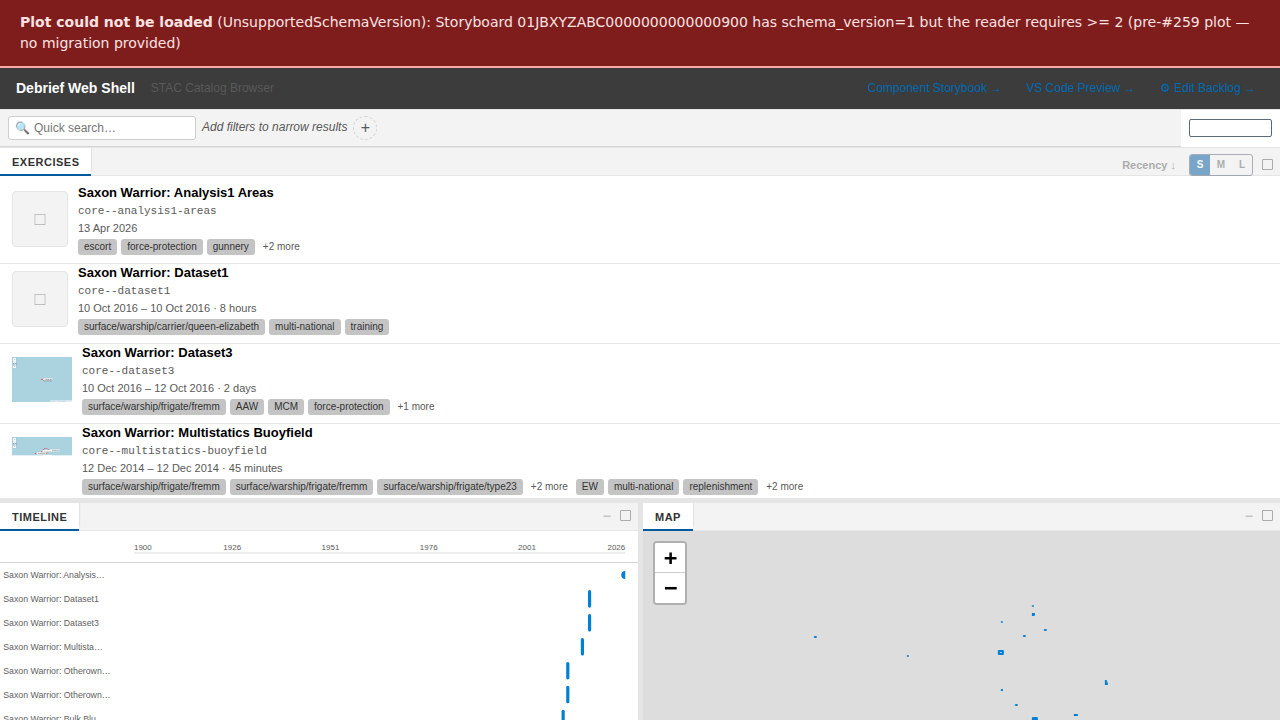 Pre-#259 plots fail loud rather than getting coerced into a guessed order.
- Replace one error with several more specific ones. Five
DuplicateTimestampErrorthrow-sites came out of the CRUD layer.DuplicateCreationOrderErrorcovers the genuine integrity violation — two scenes claiming the same slot within a tied group — andCreationOrderOutOfRangeErrorcovers reorder attempts outside the group. The error surface gets narrower and more truthful, not broader. - Ship the CRUD, defer the gesture.
reorderSceneInTiedGroup()is wired and tested; the drag-handle or keyboard affordance to invoke it from the panel is a separate feature. Splitting this way keeps the schema change reviewable on its own.
The Aggressive-Deletion Tax
The original plan claimed deleting DuplicateTimestampError would only ripple inside shared/components/src/storyboard/. In practice three consumer flows — the VS Code capture command, the VS Code edit-suite (duplicate + copy-to-other), and the web-shell capture command — had built entire Replace/Offset/Cancel banner machinery around catching that one error. Removing the constraint at the data layer made roughly 250 lines of UI orchestration unreachable. We took the aggressive-deletion path rather than leave dead code on a code-search.
What’s Next
- The reorder gesture.
reorderSceneInTiedGroup()is in but has no UI affordance yet. A drag-handle on the scene row plus a keyboard alternative (Alt+↑ / Alt+↓ within a tied group) is the natural follow-up. - A visual cue for tied groups. Three scenes at
10:30:00Zrender with three identical DTG labels (301030Z MAY 26). Users can disambiguate via the title edit field, but a light hint (“…+2”) on the timeline strip would make the tied state legible at a glance.