What We Built
A storyboard is only as good as the moments it captures. If an analyst frames a wide view of three vessels converging and then a tight close-up on the interception, the rectangles on the map should look like that — wide, then tight — and clicking each one should put the audience back exactly where the author left them, including whether they were watching full tracks or just trailing wakes. Four small gaps surfaced during field testing of PR #606 broke that promise in different ways, and this change closes all four together.
| Before | After |
|---|---|
| Every scene rectangle was the same ~100m square at the scene’s centre, regardless of how the author had framed the view | Each rectangle traces the actual viewport bounds at capture time — wide context shots look wide, tight close-ups look tight |
| Clicking a scene captured in Trail mode silently played it back in Full mode | The display mode is captured with the viewport and restored on playback, so Trail-mode scenes stay in Trail |
| The currently-playing scene’s rectangle was indistinguishable from the others on a busy map | The active scene picks up the same drop-shadow + pulse halo that selected tracks already use |
| Scenes rendered as peer leaves in the feature list, scattered between tracks and other features | Each Storyboard folds its child Scenes under a single collapsible parent row, mirroring how Tracks group their Positions |
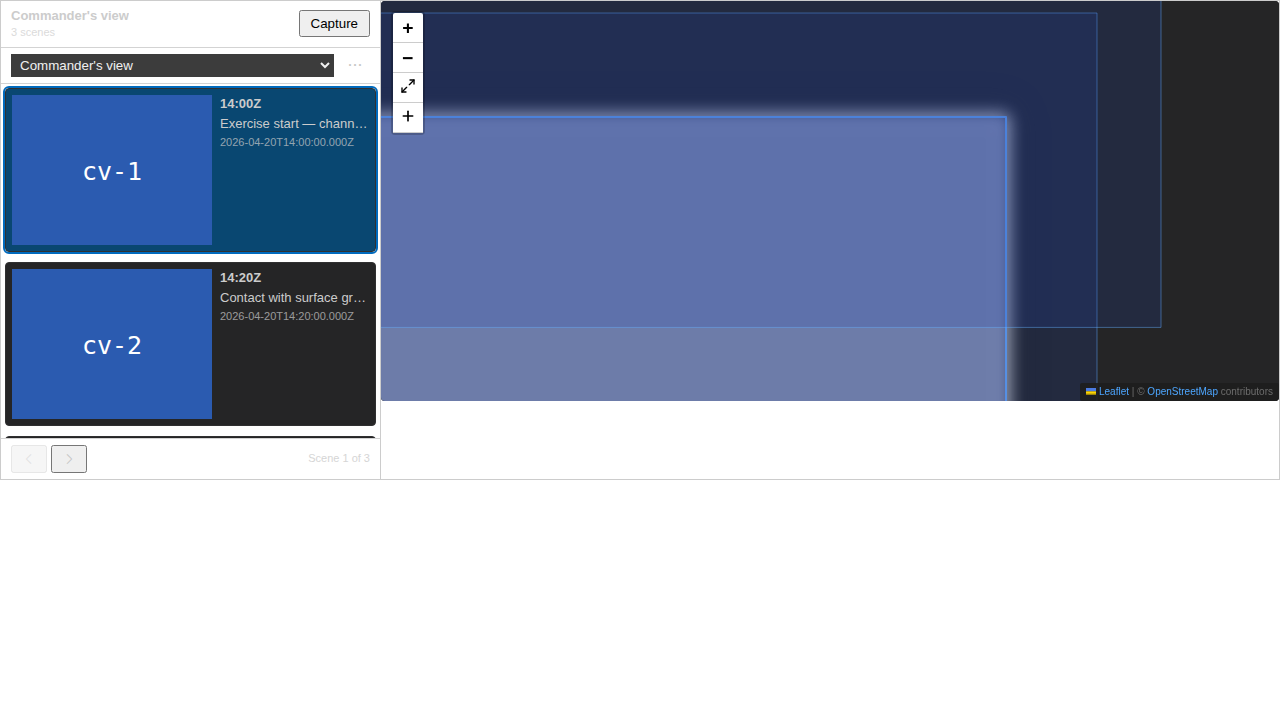 The currently-playing scene’s rectangle picks up the same drop-shadow halo that selected tracks already use. The non-current rectangle (outer) has no glow.
Concretely: scenes now carry a display_mode (Full or Trail) and restore it on playback alongside the viewport; rectangles are computed from the real Leaflet bounds at capture time instead of a placeholder square; the active scene gets the canonical track-selection halo; and the feature list groups each storyboard’s scenes under a collapsible parent row instead of mixing them in with tracks.
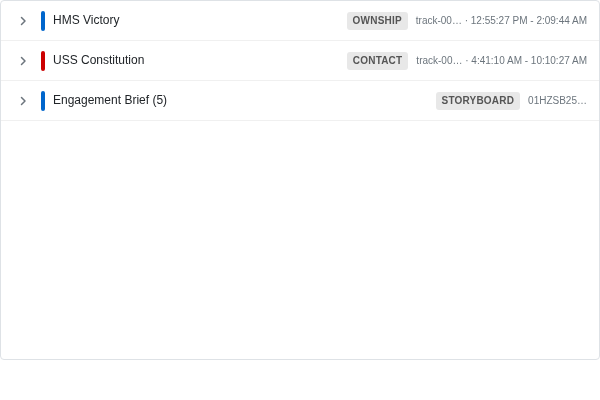 The new Storyboard row in
 FeatureList — one collapsible parent with a (5) scene-count badge, sitting alongside tracks instead of cluttered between them.
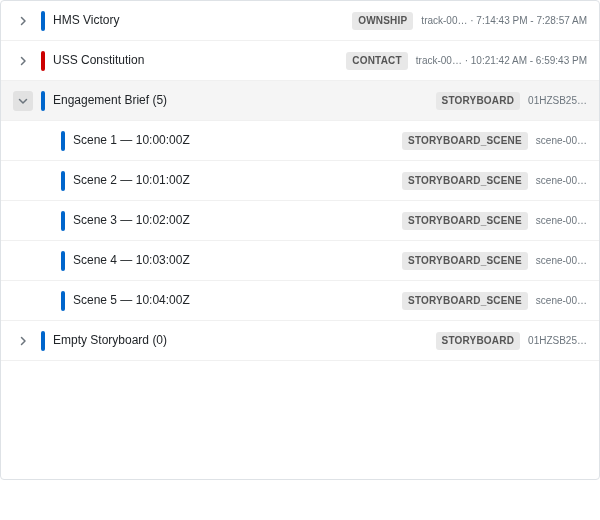 Expanded, the parent reveals its five scene children indented one level. An empty storyboard (bottom) still renders with
 (0) and a disabled chevron — FR-013 — so authors never lose track of a storyboard whose contents they’re about to capture.
How It Fits
This is a fast follow-up to PR #606 — which introduced scene-click navigation under the E13 storyboarding epic — tidying the seams that field use exposed. The schema edit lands in storyboard.yaml and regenerates Pydantic and TypeScript through the usual LinkML pipeline; the rendering and grouping changes ride on existing surfaces (SceneRectangleLayer, FeatureList/flattenFeatures.ts) rather than introducing new ones. Nothing here is architecturally new — it’s the storyboarding feature growing into the conventions the rest of the map and feature list already follow.
Key Decisions
- Reference the existing
DisplayModeEnum, don’t duplicate it. The newdisplay_modeslot onScenepoints at the enum already defined insession-state.yaml. Article II.1 of the constitution is explicit about single source of truth for schemas, and a parallel enum would have drifted within a release. - Reuse the track-selection halo, don’t invent a new “active scene” treatment. The BACKLOG entry originally suggested a
var(--vscode-focusBorder)style, but the existingdebrief-map-feature--selectedCSS — drop-shadow plus pulse — is already the project’s vocabulary for “this is the one you’re looking at”. Borrowing it makes scenes feel like first-class map features instead of a bolted-on overlay. - Use Leaflet’s own
getBounds()+containerPointToLatLng()for the viewport polygon. The alternative was hand-rolledL.CRS.EPSG3857.latLngToPointmath. Same result, much less code to review, and Leaflet already handles the edge cases (wrapped longitudes, non-standard CRS) we’d otherwise have to rediscover. - Tolerate legacy scenes; don’t migrate them.
display_modeisrequired: falsein the schema, so scenes captured before this change still parse. On read, the time controller is left untouched whendisplay_modeis absent, and the placeholder polygon is recomputed at render time. No batch migration script — Article III.2 source-preservation means we fix things opportunistically rather than rewriting on-disk catalogues. - Ship all four gaps together. They look like four independent fixes but they aren’t: display-mode capture is the precondition for the rectangle and halo work to render the author’s intent; the active-scene halo is the same selection treatment the grouped rows need to surface; and all four touch the same
SceneRectangleLayerand feature-list data flow. Splitting them would have meant landing a partially-fixed playback experience and revisiting the same files twice more. - Group scenes in
FeatureList, not the “Layers panel”. The BACKLOG entry called the affected component the Layers panel, but the actual surface isFeatureList— and its existing parent/child machinery (already proven forTrack → Position) was the obvious place to land STORYBOARD → STORYBOARD_SCENE rows.
Provenance, Not Heuristics
The polygon-fidelity gap had a tempting shortcut: detect the ~100m placeholder by its bounding-box width and recompute on the fly. The first round of planning headed that way. The review caught it: a real survey-scale capture (a single buoy from a few hundred metres up) would be misclassified by exactly the same heuristic. The fix added an explicit _polygon_source provenance slot to SceneProperties — values bounds, placeholder, or manual — that the renderer consults at draw time. A fresh capture writes bounds; absent or anything-else triggers a render-time recompute from (viewport, map.getSize()) using containerPointToLatLng. The on-disk geometry is never rewritten; only what’s drawn this frame changes. Article III.2 source preservation is honoured by construction, not by a separate batch job.
The same pattern carries through crud.ts. The legacy viewportToPolygon(viewport) helper, called from three places — createScene, updateScene, and restoreScene — became bboxToPolygon(bounds, source), with TypeScript strict mode flagging every site that hadn’t been updated. The “third caller” the original BACKLOG entry hadn’t catalogued (in the restore path used by undo-delete) silently regressing to placeholder polygons on edit would have made this feature half-work and twice-fix.
By the Numbers
| Metric | Result |
|---|---|
| New + extended tests | 27 (6 schema round-trip, 9 crud, 6 SceneRectangleLayer, 6 flattenFeatures) |
| Pre-existing tests still passing | 2,845 (TS + Python combined) |
| Total tests at HEAD | 2,872 passing, 0 failing |
| LinkML enums added | 1 (PolygonSourceEnum) + 1 mirrored (DisplayModeEnum from session-state.yaml) |
New SceneProperties slots |
2 (display_mode, _polygon_source) |
crud.ts call sites migrated |
3 (createScene, updateScene, restoreScene) |
| Hosts touched | 2 (VS Code extension, web-shell) |
| New runtime dependencies | 0 |
Lessons Learned
- Cross-file LinkML imports vs gen-json-schema. Pointing
storyboard.yamlatsession-state.yaml’sDisplayModeEnumlooks like the obvious right move — and it is forgen-pydanticandgen-typescript. Butgen-json-schemaruns over a deliberately reduced subset (debrief-jsonschema.yaml) that excludessession-state.yamlbecause of an upstream bug withCoordinate as multivalued class range. Importing transitively re-introduced the bug. The pragmatic answer was to mirror the enum’s permissible values intostoryboard.yamlwith a comment pointing at the canonical source. Article II.1 holds: the canonical declaration stays insession-state.yaml; the mirror is treated as a generator-shim until the upstream bug is fixed. - The “third caller” tax. When a helper’s contract changes —
viewportToPolygon(viewport)→bboxToPolygon(bounds, source)— TypeScript strict mode flagged every site that hadn’t been updated, including one the original plan hadn’t catalogued (in the restore path used by undo-delete). The cheap-to-do change is the helper signature; the actual work is the three call sites that need bounds threaded through. A grep + a deleted legacy signature is the right tool, not an@deprecatedannotation that lets stale callers ride. - Provenance is the legacy-data answer. Geometric heuristics for “is this a placeholder?” fail on legitimate small captures. An explicit provenance slot survives every future evolution of the schema unchanged; the renderer’s decision becomes a one-line lookup instead of a magic threshold.
- Keep the panel presentational; let the host apply. Restoring
display_modeon scene-click could have lived insideStoryboardPanel— it has the row click handler. But the panel is a shared component used by both VS Code and the web-shell; teaching it to reach into the session-state Zustand store would have coupled the presentational layer to runtime services. Each host already owns its session-state store; each host wires the same one-liner (session.setDisplayMode(scene.properties.display_mode)) at its boundary. Article IV.1 — the panel signals, the host applies.
What’s Next
- The new
_polygon_sourceslot opens the door for'manual'-source scenes — author-drawn rectangles that don’t track a captured viewport. That’s the next storyboarding feature on the horizon. - The orphan-scene
console.warn(Article I.3, FR-014 edge case) is currently best-effort. A formal recovery flow — “your storyboard reference is broken, here’s how to fix it” — is captured in the BACKLOG for the next storyboarding wave. - Web-shell scene-click playback only restores display mode today; the viewport flyTo wiring on click is still on the to-do list. VS Code has both paths via
storyboardPlayback.executeTransition. Closing the web-shell symmetry is straightforward once a dedicated playback service lands there.